

Air India will introduce a phased increase in fuel surcharges across its domestic and international network, the airline announced today, citing a sharp rise in jet fuel prices driven by the Iran-US war in the Middle East.
The carrier gave a slab of rates that it will implement in three phases. Air India said it regrets the move but described it as unavoidable, attributing the decision to factors beyond its control.
Air India said that without the surcharge revision, some flights risked becoming commercially unviable and could face cancellation.
"Absent such fuel surcharges, it is likely that some flights would be unable to cover operating costs and would have to be cancelled," it said.
For flights to the Middle East, the fuel surcharge will be $10; for flights to Africa, it would be raised by $30 to $90, and for Southeast Asia flights it would be raised by $20 to $60.
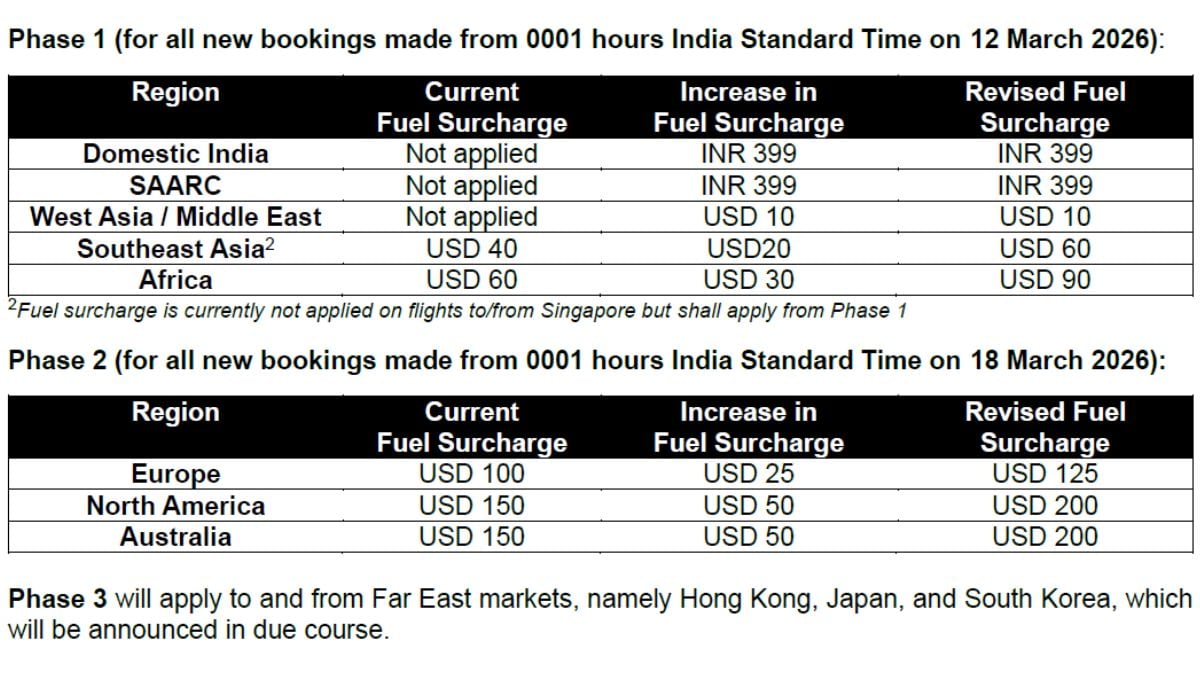
The airline will review the surcharges periodically and adjust them as the situation evolves, Air India said.
Air India Express, Tata-run airline's low-cost arm, will not apply any fuel surcharge on its flights for now. This may offer some relief to passengers.
"Since early March 2026, aviation turbine fuel (ATF), which accounts for nearly 40 per cent of an airline's operating costs, has seen significant price escalation due to supply interruptions. In India, this pressure is amplified by high excise duty and VAT on ATF in major metro cities such as Delhi and Mumbai, magnifying cost the impact and placing substantial strain on airline operating economics," Air India said in a statement.
Jet fuel has long been one of the most volatile input costs for airlines. India does not produce significant quantities of crude domestically, making carriers directly exposed to global oil price swings.
The Iran-US war in the Middle East has also affected the supply of natural gas across the world. The Strait of Hormuz remains a part of the war zone for over two weeks, due to which more than 750 cargo ships are stuck at major ports in the region.
India buys 50 per cent of its natural gas needs from the international market. Of this, it imports 20 per cent from Qatar.
After Iran's missile attacks on Qatar's gas fields, the world's largest natural gas exporting company, QatarEnergy, stopped production. This has affected supply of natural gas to Asian regions.
To deal with this growing challenge, India has guidelines for regulating the supply and use of natural gas in different sectors across the country. According to the new guidelines issued by the Ministry of Petroleum, the central government divided key sectors into four priority areas.
from NDTV News- Special https://ift.tt/CoYcwm2
via IFTTT


 Orai is a city and a municipal board in Jalaun district in the Indian state of Uttar Pradesh. It is the district headquarters for Jalaun District.
No comments:
Post a Comment